Introduction
When selecting screening materials in South Africa, one question often arises: perforated plate or woven wire mesh?
Both materials are widely used across mining, manufacturing, processing plants and industrial filtration systems. Both offer strength and durability. However, their structure, performance characteristics and ideal applications differ significantly.
Choosing the correct material directly impacts screening efficiency, wear life, throughput and maintenance costs. Understanding these differences ensures your system performs reliably under real operating conditions.
This guide compares perforated plate and woven wire mesh to help determine which solution best suits your application.
What Is Woven Wire Mesh?
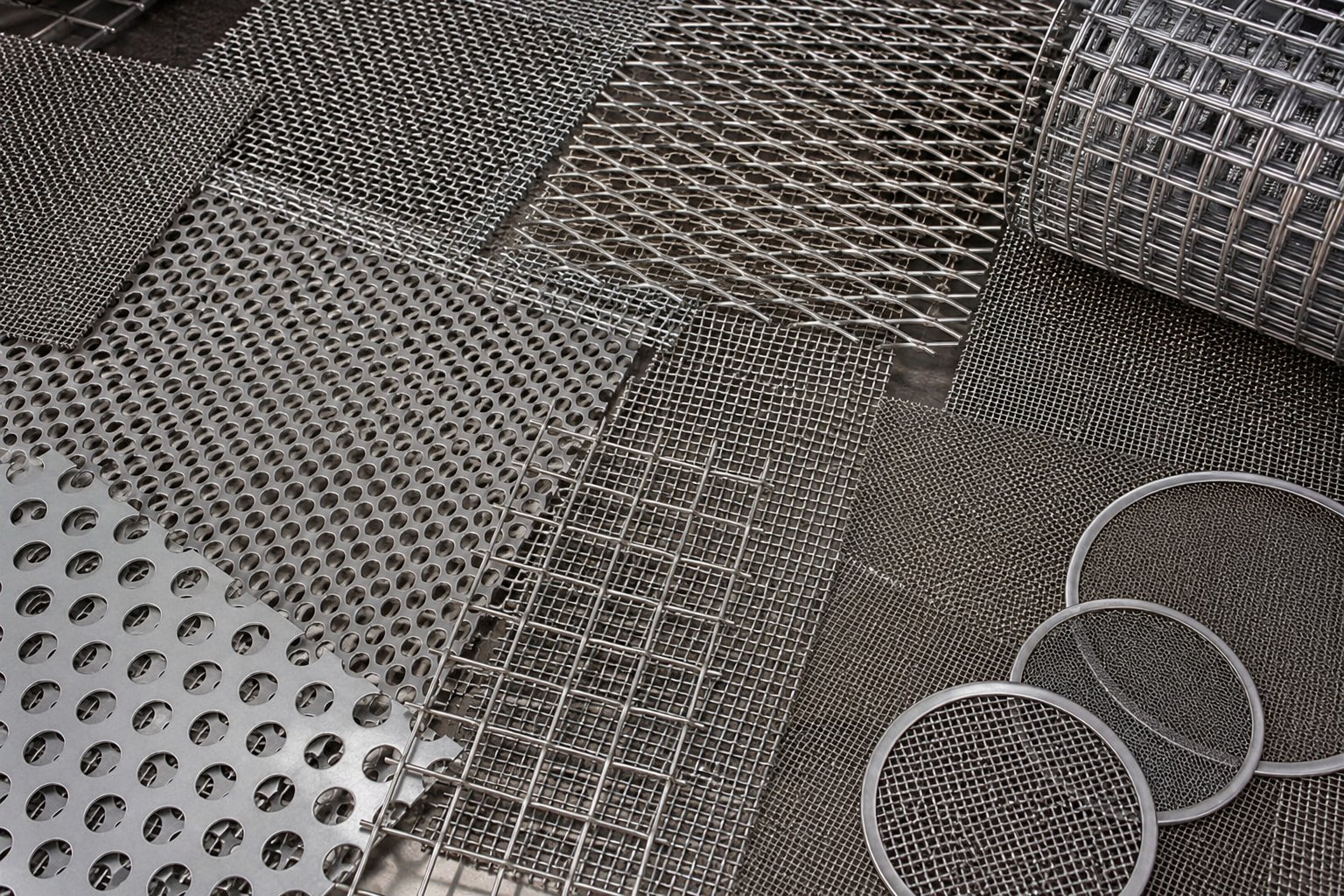
Woven wire mesh is produced by interweaving metal wires into defined patterns. The weaving process creates controlled apertures that regulate material separation and filtration accuracy.
Industrial woven mesh is valued for:
• Precise separation
• Flexibility under vibration
• High open area
• Adaptability across applications
In South Africa, woven wire mesh is commonly used in vibrating screen systems within mining and aggregate processing environments where continuous movement and impact are present.
Explore woven wire mesh here: /woven-wire-mesh/

What Is Perforated Plate?
Perforated plate is manufactured by mechanically punching holes into flat metal sheets. The result is a rigid panel with consistent hole size and spacing.
Perforated plate combines structural strength with practical performance and considered visual appeal.
It is commonly used in:
• Heavy duty screening
• Structural walkways and platforms
• Ventilation systems
• Protective guards
• Architectural applications
Perforated plate is particularly suited to environments where rigidity and load bearing capacity are essential.
Learn more about perforated plate here: /perforated-plate/

Key Differences Between Perforated Plate and Woven Wire Mesh
Understanding how these materials differ helps determine which is appropriate for your system.
1. Structure and Flexibility
Woven wire mesh retains flexibility due to its interwoven construction. This makes it ideal for vibrating screen decks and dynamic systems.
Perforated plate is rigid and does not flex under load. It is better suited to static installations or structural applications.
2. Open Area and Throughput
Woven wire mesh typically offers higher open area percentages. This allows for greater material throughput and improved screening efficiency.
Perforated plate generally has lower open area due to the punched hole structure. However, it provides greater durability in abrasive conditions.
3. Strength and Wear Resistance
Perforated plate offers superior structural strength and impact resistance. It is often selected in heavy duty industrial environments where mechanical stress is high.
Woven wire mesh provides strength relative to wire diameter and weave type, but may experience wear more quickly in highly abrasive applications.
4. Precision and Filtration
Woven wire mesh allows for fine aperture control, making it suitable for accurate particle separation and filtration systems.
Perforated plate is typically used for coarser screening and structural flow control rather than fine filtration.
5. Maintenance and Replacement
Woven wire mesh is generally easier and more cost effective to replace in vibrating systems.
Perforated plate, while more durable, can be heavier and more complex to install or replace depending on system design.
When to Choose Woven Wire Mesh
Woven wire mesh in South Africa is often preferred when:
• High screening accuracy is required
• Vibrating systems are in use
• Fine particle separation is critical
• High throughput is necessary
• Flexibility is required under load
Woven mesh is widely used in mining, mineral processing and aggregate operations.
When to Choose Perforated Plate
Perforated plate is typically selected when:
• Structural rigidity is required
• Impact resistance is a priority
• Applications involve static installations
• Heavy duty screening environments are present
• Load bearing performance is essential
It is commonly used in industrial walkways, ventilation systems and protective screening structures.
Which Is Right for Your Application?
The correct choice depends on your system design, material characteristics and performance priorities.
If your operation depends on high accuracy and efficient throughput in a vibrating screening environment, woven wire mesh is often the preferred solution.
If structural strength, impact resistance and durability under heavy load are primary concerns, perforated plate may be more suitable.
In many industrial systems, both materials are used in different stages of the process to optimise performance.
Supporting Screening Systems
For applications requiring tensioned mesh panels, see: /tensioned-screens/
For integrated screening components such as screen packs, visit: /rimpacks/
Conclusion
Perforated plate and woven wire mesh each serve critical roles in industrial screening systems across South Africa.
Understanding their structural differences, performance characteristics and application suitability ensures that systems operate efficiently, safely and with reduced downtime.
Industrial Mesh Supplies provides both perforated plate and woven wire mesh solutions, supporting industrial environments where durability and reliability are essential.
Explore our full product range at https://industrialmeshsupplies.co.za/screening-and-mesh-products/